|
Objekt / Object:
|
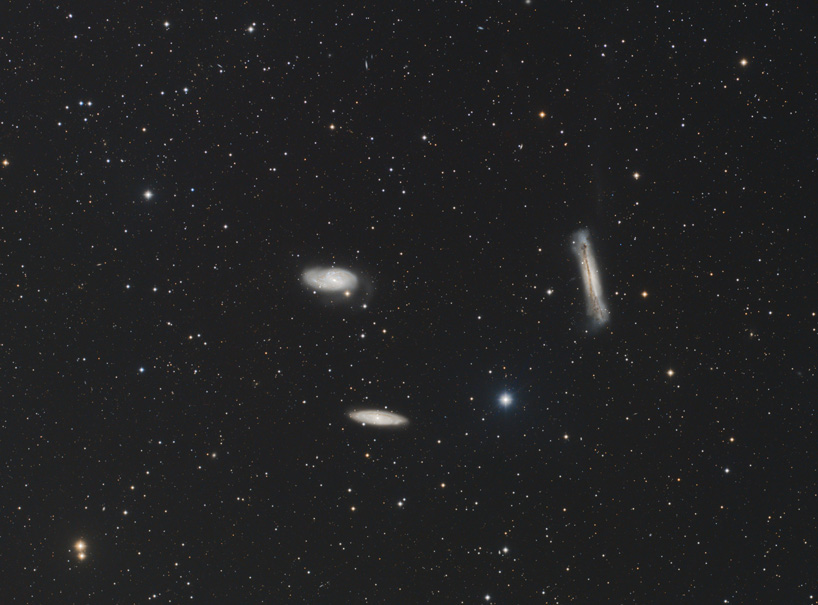
Das Leo Trio bestehend aus den Galaxien M65 (unten links), M66 (oben links) und NGC3628 (rechts) im Sternbild Leo (Löwe).
Ansatzweise erkennt man den Gezeitenschweif, der von NGC3628 nach oben verläuft.
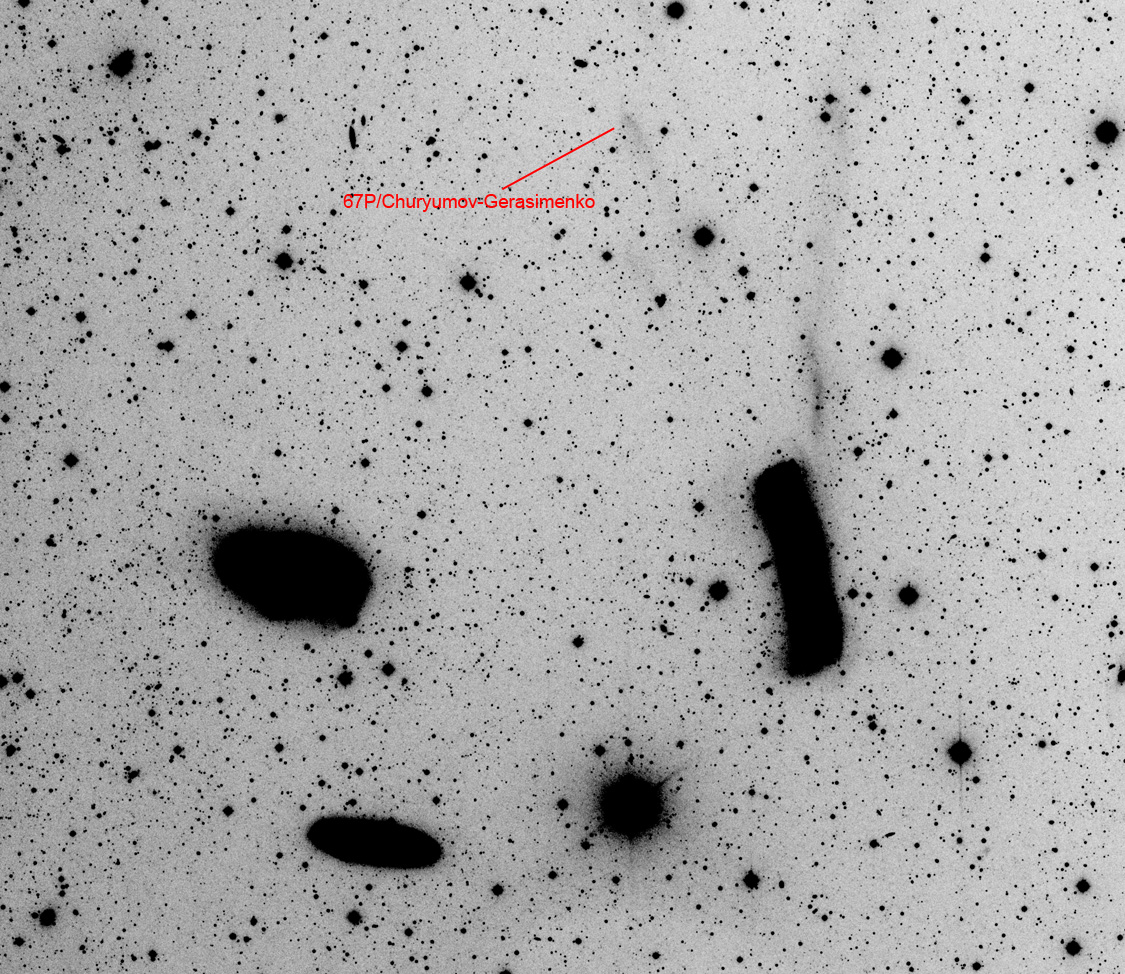
Noch besser läß er sich in dem invertierten Bild weiter unten erkennen.
Das invertierte Bild zeigt auch eine Spur des Kometen 67P/Churyumov-Gerasimenko. Dieser erlangte Berühmtheit
durch den Besuch der Raumsonde Rosetta und des Landers Philae im Jahr 2014.
The Leo Trio consists of the galaxies M65 (lower left), M66 (upper left) and NGC3628 (right) in the constellation Leo.
At a closer look you can notice the tidal tail of NGC3628 that extends to the top of the image.
The inverted image below shows it even better. It also shows a trace of comet 67P/Churyumov-Gerasimenko that
was visited by the space probe Rosetta and it's lander Philae in 2014.
|
|
Objektentfernung / Objectdistance:
|
ca. 40 Mio. Lichtjahre / light years
|
|
Datum / Date:
|
Mehrere Nächte im April 2016
Several nights during April 2016
|
|
Zeit / Time:
|
L: 32 x 900s, R: 12 x 600s, G: 13 x 600s, B: 15 x 600s, Total ca. 14,7h
|
|
Ort / Location:
|
DeepSkyWest, New Mexico
|
|
Instrument:
|
Takahashi FSQ 106EDX
|
|
Montierung / Mount:
|
Paramount MyT
|
|
Kamera:
|
QSI683wsg
|
|
Nachführung / Guiding:
|
OAG
|
|
Filter:
|
Astrodon
|
|
Bemerkung / Note:
|
Norden ist rechts.
Kalibrierung (Dark und Flat), Registrierung, Kombination und Farbkalibrierung und Gradientenentfernung wurden mit meiner Software
Regim vorgenommen.
North is right.
Calibration (dark and flat), registering, combination, color calibration and gradient removal were done with my software
Regim.
|